Tuesday, May 7, 2013

Ferry Repair

'Tis the season for repairs, as owners realise their boats are in no fit state to go in the water, and time is slipping away.


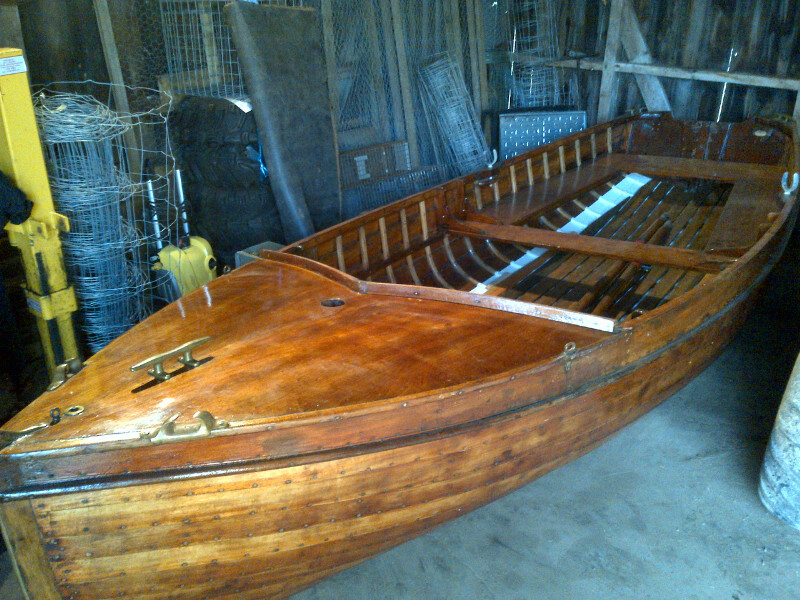
This is a nice example of a Scottish-built former ferry, retired into private hands no doubt due to issues with maintenance or safety. She had every kind of mastic in the lands to keep out the water, when what she needed was more water between the lands to make them swell and keep her watertight. Clinker is the only boat building method that requires a boat to be leaky in order to float.


That's the theory, and a bit simplistic as a tight clinker boat will not leak and never will, especially those with a thin bead of something brown and rubbery between the lands.


This boat may well need some time to take up. We will see, but after 28 hours of scraping out every inch of her, including the accumulations of paint between timbers and planks, and doubling the worst splits, she bloody well better not leak too much to begin with...


Thursday, April 25, 2013

Two Go South

The second of the restored estate boats goes home today. The first, a Frank Knights-built mahogany on oak 16-footer, which needed a complete strip, retimbering and plank repair; the second, an elm-planked 10-footer that had been badly converted from a sailing boat and coated in B&Q shed paint. This, ironically, had probably preserved her until it was time for another strip down and retimbering.


Both are ready to go back in the water and, as a bonus, the owner is arriving today with a few choice cuts of pork from his own pigs. Fair exchange, I would say for all that scraping.


Meanwhile there's another old clinker boat waiting to go in the shed for a pre-season sprucing up.

Maybe it's the time of year, but there have been a number of approaches recently for the restoration of old clinker boats, some feasible, some not. I insist on a few photos beforehand and they can be very revealing, and save the expense of a wasted visit. For example, what would you do with a boat like this?


Or this?

Both owners suggested that it might not be impossible to bring them back to life. To which I replied, honestly that "anything is possible, if you are prepared to pay for it". But better by far to take off the lines and build afresh. I fear it is unlikely to happen.

Maybe there are boats worth restoring and others that should be allowed to revert gently to nature, as we all will one day.


Wednesday, April 24, 2013

Anyone for Sjektes?

Anyone in the market for an 18ft open boat, based on a Norwegian sjekte design called Jan from the 1930s, either with a gunter or bermudan rig, is spoiled for choice. Both Felicity John and Florence Oliver, the boats I built a few years back are on the market for around £4,500 and £6,500 respectively.


I know this as a potential client, with whom I had been discussing a cabin version, decided to see Felicity John for himself, and after I contacted the owner to arrange a meeting, found her for sale. That could be a bit of a bummer for me, as I suggested in my last post, as it may scupper the chance of building a nice new, purpose-built boat. Hy ho.


While popping a lid on Karsten Ausland's Jan does look quite attractive, modifying Felicity John could be fraught with "issues" of strength and space. It could be done though, at the risk of making a dog's breakfast of a beautifully, pure open boat, as both I and my client are well aware.


The cost of modification might be a few thousand quid on top of the purchase price; the cost of a new boat perhaps a third more, so I will just keep my fingers crossed with the look of a man who has "done the right thing". Whatever happens, the important thing is that the right boat gets into the hands of the right owner.


Which made me think: maybe I should become a boat broker and give up the business of building them. Are there not quite enough boats to go round already? Do we need any more boats, especially of the sort that sit in garages and slipways year in, year out without so much as a sniff of water?

Why not call a moratorium on new boats until all the ones we have are in good hands and being used. Just a thought, albeit not the kind of idea likely to appeal to boat builders.

Friday, April 12, 2013

Boat Builder's Dilemma: Florence Oliver For Sale

Florence Oliver, the 18ft sjekte I built some years back, is for sale. She is a favourite of mine, and I vividly remember how she came about.


It was during the Caledonian Raid and I had entered Felicity John, the first sjekte I built after leaving Ullapool Boat Builders. I was pretty knackered as she was my first commission on going alone, and the prospect of building another one so soon seemed a little daunting, so I did my best to dissuade Ted.


These days I would have bitten his leg off, but maybe my reluctance helped fuel his enthusiasm. Anyway, he proved more persuasive than my efforts at evasion and I eventually agreed to build what was to become Florence Oliver.


And very proud I was of her too. With spars by Collars, sails from Steve Hall at North Sea Sails, and nicely finished by Ted, no mean craftsman himself, she made her debut at Beale Park in 2007.

Recently I was asked to quote for a similar sized boat, but with a simple cabin, and although modifying FO would have been nigh impossible, I felt duty bound to mention that she was for sale. I confess, however, that I hesitated before handing on the news. What if my putative client fell in love with her, and my commission evaporated? And yet I owed it to Ted to try and find a buyer for his boat. Matching owner to boat is, after all, what it's all about.


Ted, on his part, bless him, was equally concerned that I might be losing work by putting him in touch. Keen as he was to find a buyer for her, he would feel awkward if her sale meant my losing the chance to build another boat. What should I have done?


Fortunately (or unfortunately) Florence Oliver is probably not going to be suitable and at least my new client, if that turns out to be the case, will get a chance to talk to Ted about my skills or otherwise. It may mean Ted has to wait to sell his boat, and it may not lead to a new commission for me, but my conscience will be clear, and that is worth more than any boat's worth.

Meanwhile, anyone looking for a clinker-built 18-footer, one careful owner...? 


Thursday, March 28, 2013

It's Amazing What You Find...

...underneath a thick layer of red fence paint. At least it helped preserve a little dinghy that was on her last legs, and destined as a flowerbed, if the present owner hadn't spotted her on eBay.

Before...

I have to say that she is the prettiest little dinghy I have seen for a long time, and most exquisitely put together, although the thwart knees do look a little heavier than strictly necessary.

One of the intriguing things about her was that she was orginally a sailing dinghy. You can see where I have glued in an oak filler in the slot. The trouble was that, in stripping out the centreboard case a lot of the keel's strength went with it, such that there was a horrible hump in the centre. This disappeared with a bit of gentle persuasion over a weekend, and with the slot well and truly filled, the keel is as straight as a die again. And the new timbers could then be taken over the keel to help add stiffness.

... and after.
The wood used is elm, and flawless, with no splits after what must be 30 or more years. She must have been well looked after in her youth, as the lands are not worn or scuffed, and the rubbing strip is intact. But all the steamed timbers were cracked, and had to be replaced with slightly heftier ones. Which is probably when her owner decided to put her on the market. A common thing now that the ordinary skills of retimbering a clinker dinghy reside in the hands of a handful of traditional boat builders, where once it was a routine job for an owner to steam in a new timber every so often.

So, after a great deal of scraping of red paint, and sanding and varnishing, she's ready for another 30 years. And just look at how the thwarts came up. Again, under the red Cuprinol lay some lovely Honduras mahogany to set off the elm and oak nicely.

I just wish I knew what she was. Anyone out there with a class or type? Length around 11ft, with a rig originally and centreboard. No idea what rig, but probably a little lugsail. And the builder? Almost too good to be professionally built, if you know what I mean. Just such a sweet boat. I almost wish she were mine...

PS I left the rubbing strakes in red fence paint as a reminder, and I think they look fine against the planking.


Thursday, March 7, 2013

Finished... but Where's the Proof?

Well the Frank Knight-built dinghy went down to Struy the other day and, as always, I packed a camera to capture the moment of hand over. And then forgot to take any photos.

Ah well. All I can say is that she looked pretty good with mahogany thwarts back and varnished, as was the foredeck. Those of you who (loyally) tune into this blog will be bitterly disappointed of course. But be patient: I will get some shots by hook or crook before too long.

Those of you who also take that excellent publication Classic Boat can read a little about it in the next issue.

Meanwhile I have begun work on the next one: an elm-planked 10ft dinghy that was originally fitted with a centreboard. I only discovered this today when I hacked off the crude blanking piece over the slot. If anything this little gem is even nicer than her bigger sister. I fully intend to take off the lines. Unfortunately, again, I forgot to take my camera to the workshop today. Believe me, she's a little beauty with fabulous mahogany thwarts, Honduras no doubt and unobtainable now. Bent timbers were shot though and all will be replaced.

I have a feeling she was amateur built in the days when amateurs built clinker boats, as the quality is superb, but somehow not professional. In that I mean better. It has taken more time. More care has been expended and that is so often the way. So-called professionally-built boats have a put-together-by-time-served craftsmen-to-a-timescale-and-standard quality about them, whereas amateur-built boats - that is those built by super talented amateurs who may well be brain surgeons, nuclear scientists, climate change researchers or former British Rail managers - can be exquisite. Maybe it's the quota of dedication (I was going to say love) put into them, and the (unpaid) hours.

And if you want to know how to build a clinker dinghy, then you can do worse than subscribe to the thinking man's nautical magazine, The Marine Quarterly. You will not regret it. This quarter's issue, aside from the clinker treatise in 2000 words, includes pieces on scurvy, Brixham trawlers and Thames eels.

www.marinequarterly.com

You know you should...


Saturday, February 16, 2013

Progress

The last of the new timbers were steamed in on Friday, and the last of the nails riveted up this morning. The shell now has the strength it lacked when it came into the shed a few weeks ago, plank splits are healed and the next stage it to flip her over to start varnishing the bottom, after some more remedial work on damaged lands and various divots.


Of the timbers, only three split before they could be bent to the planking, which was an excellent ratio. Nothing more annoying than having timber after timber split on withdrawal from the steam box. Well, maybe split planks in a new build at the hood end fastenings just when you've riveted the entire length.

After work on the bottom it'll be time to flip back over and finish the interior with another coat of bilge paint, varnish and the final fitting of the thwarts and floorboards. Then back where she belongs: in the water as good, almost, as new. And certainly stronger now with the slighty beefier timbers.