Wednesday, July 11, 2012

Faering Week Three


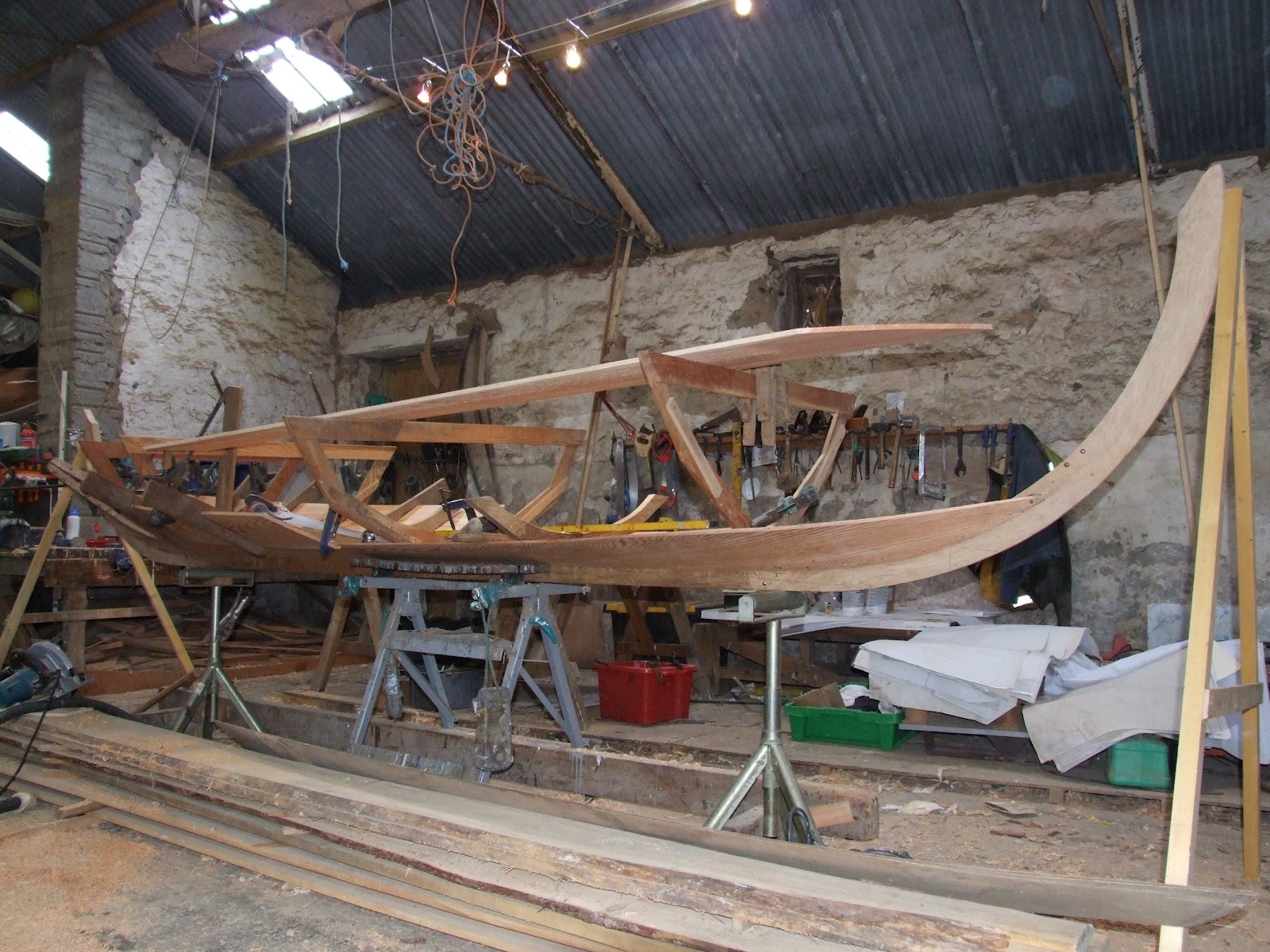
Slowly but surely, the faering is taking shape. The lovely thing about a faering (or one of the lovely things) is that with three strakes you're a third planked after fitting the garboards, and after strake two goes on you can kid yourself that it's only a matter of days.


On the downside, those three-section garboards take nearly as long as two ordinary strakes, maybe three as there is absolutely no hiding place when it comes to getting them to fit the keel and stems perfectly. With no false stem the fit has to be spot on, which is why those scarphs are so vital - the other reason being that they allow much more efficient use of timber. See how that section above came neatly out of the flared end of a board?


With the garboards now fixed, the fore and aft sections of the second strakes were cut from patterns I made when I built the first Woodfish in 2006 and although they are not accurate enough to trust alone - besides this faering is 16ft as opposed to 15ft 4in - they do serve as a pretty close approximation of the plank shape. There is a lot left to eye despite Iain's detailed plans. For example, I have given the stem more of an up turn as the owner wants to mount a dragon's head, which means a bold, forward stare; not one looking downwards. I think I'll modify the sheer too, which means altering the top strake a bit. Sorry Iain; that's what comes when you work with solid timber.


The frames are in too, which helps define the shape and was the reason why moulds three and five were not necessary. The frames go into the garboards, and from then on they dictate the shape at those stations. The cross pieces are also fitted, notched over the frames and held temporarily at the centreline by a lashing.

It took me a day to fit and nail that lot up and tomorrow I plan to fit the forward sections. Slowly, slowly does it as a millimetre out at the stems and it shows. NB the after sections are fitted first or the scarphs would point the wrong way.


I have also decided not to use any mastic in the lands, which calls for close fits all round and as I am using copper nails not screws, there's only one chance to get them into the hood ends. All for the sake of authenticity. The owner also wants me to use gun blue on the copper to make it blacken like iron. Jury's out on that one, but early experiments are hopeful.

All the while I am aware that this is not the traditional way to build a faering but then, as I have said before, I'm not Norwegian with a lifetime's experience behind me, in which case I would be half finished by now (three weeks for goodness sake) my only tools being an axe, some sticks from the ceiling and a pile of pine.

Now one thing I can say is, to hell with knotty pine, my larch is the finest I have seen since I began building boats. Just one know in the whole boat so far. Where from? I'm keeping it a secret...


Saturday, July 7, 2012

Faering Progress

The backbone and garboards of the faering are now nearing completion. The garboards are in three pieces which makes it slightly easier to get them to fit closely along the keel, but also involves six separate operations. So it's probably slower, but surer. And more timber efficient, certainly.


Crucially it has meant I could use some pieces of larch that normally would have languished in the shed; notably two arrow-shaped sections from a board that perfectly matched he scimitar-like fore and aft sections of the garboards.


Thus wastage to date (and it would be a crime to waste a square inch of the superb larch I have seasoning) has been minimal. Whilst it wold have been nice to build in the traditional way with time-worn sticks from the roof to spread the strakes; alas, I have not the experience and rely thus on Iain Oughtred's detailed plans, from which I have made six moulds and three templates for the strakes (three a side).


Three garboard sections per side, scarphed using the curious but logical stepped scarph,  means steaming two fore and two aft sections into the stems, With no rabbet, just a bevel on the planks, there is little room for error. Simple, yes, but you have to take your hat off to the old viking builders. I bet their joints were fag-paper thin (if tobacco had been available).


Again, I marvel at the efficient use of timber; the entire side of a faering could be got from a single wide plank, presumably of oak riven, not sawn. As for steaming the tricky fore and aft sections, I have seen an old b/w film where the men of Os clamp them into wooden moulds, which are infused with steam - I use a plastic bag to get them to twist up into the stems.

Next stage (the photo below was taken during the build of the first Woodfish) is to make and fit the frames to the garboards which will set the shape.


One thing I had been asked to do, for authenticity, was use iron rails. This I had to refuse, so as a compromise I have been painting each of the exposed nails and roves with gun blue, a selenium dioxide (I am told) solution used to blue the steel of shotguns. It seems to work and the copper looks a bit like black iron.


He also wants a steerboard, which should be fun...


Saturday, June 23, 2012

Back to Work

It's been almost a month, during which time my Vertue Sally has been gven a 75th birthday makeover, the Tammie Norrie was finally delivered to Glen Affric, the Land Rover gave up the ghost; we sailed through the Sound of Harris to the remote Monach Islands... and much more besides.

Sally spent a day on legs in Loggie, where she had a fresh coat of enamel and antifouling, decks repaired and repainted and much more besides. Her mast, which had been out for over a year, is now back, freshly varnished (10 coats plus two of Hempels Woodseal Primer, alas, now discontinued). She now has a chartplotter, as the old GPS (circa 1990 something) refused to acquire any satellites. And that's the truth.

Sally refitting in Loggie Bay
There's a new (well I say "new", when it dates from 1997) 300 tdi Discovery in the drive, and already showing idiosyncracies, which is maybe why the last owner decided to part with it. Squealing from the fan belt tensioner is only the least worrying symptom. We'll see...

There's been a bit of boat building too: the opening stages in two new boats for delivery in the Autumn. The first is an Iain Oughtred Sula, a 17ft Shetland yole, one of a very few that Iain designed from scratch for solid wood construction, and the other is a 16ft Woodfish faering, again designed traditionally.

Which means two boats building side by side, a first for Viking Boats (but don't expect it to be a regular occurence).

The Shetland boat will be built using larch, almost exclusively for centreline and framing, while oak is the  material of choice for the Woodfish, but planked in larch, of which I have a superb stack seasoning.

The Woodfish will have a square sail, though not of my making, and a steerboard as the owner is very much into Viking boats and wanted something to  represent the recent Ardnamurchan find, so a faering sounded like the best equivalent without going into huge expense recreating a boat from scratch.

In the workshop are two sets of stems, waiting to be scarphed to their respective keels. The Sula is a bigger, far chunkier workboat, while the faering is a delicate, slip of a thing.

Mattis will be back in July, fresh from a stint at Kai Linde's shop in Norway, fired up and ready to put his considerable skills to work on a boat close to his heart. While he will be working on the Sula, I will tackle the faering's delightful structure, possibly the most efficient use of timber I can think of in a boat. Nothing wasted.

So, a busy summer ahead. Just hope the weather stays like this (generally superb, dry, sunny) and we don't get hammered like they are in the South. Makes a change.

Friday, May 18, 2012

Time for Sally, Ffly and St Kilda

With the launch of the Arctic Tern, and before the arrival of the larch to build the Sula, it was time to take stock, clear the shed, burn the rubbish, sharpen the tools, fettle the Flying Fifteen and make a start on the work needed on Sally II, my own boat.

In fact I have earmarked most of May to work on my own boats, paint the gable end, mow the lawn, and get some sailing in.

Alas: the only sailing so far has been racing Ffly and a fabulous trip on the Dutch Tall Ship Wylde Swan to St Kilda. Leaving Ullapool in the morning, we were through the Sound of Harris by nightfall, and made the islands before dawn.


St Kilda? Go there if you get the chance, preferably on the Wylde Swan which one of her crew described as "a Tall Ship on deck and a spaceship below" which reflects the cool, clean, warm, modern accommodation, in bunks and hammocks. Hard tack and salt horse? Hardly: home-made bread, cakes, soups and a bar, open soon after the sails were furled and all was squared away for dinner.


Based in Makkum, she is billed as the world's largest topsail schooner; a converted herring chaser from the early 1900s.


However, for the best photo of her under sail, coming to in Ullapool, go to Angus Bruce's website at: http://www.highlandpix.co.uk/

Here she is anchored off Village Bay, Hirta in May.


The island itself has been written about extensively and lyrically, so nothing (much) from me then. A sense of sadness; a sense of how hard life must have been and an impression of extraordinary beauty, at least under the warm spring sunshine. In a full Atlantic gale, god help them.


And how do you fancy scaling these cliffs in search of gannet eggs, using a horse hair rope...


Wednesday, April 25, 2012

Talk About Just in Time...

The sails arrived from Steve Hall at North Sea Sails just a day before the owner, and the day the spars arrived was the day Mattis and I finished the daggerboard case, and finally hung the rudder and put the final coat of varnish on and, and...

But here she is, rigged and almost ready to launch, had not the heavens opened just at the wrong time. Hopefully (although the forecast is rubbish for Thursday) we'll bend on the sails and slip her into the water tomorrow.

Enough: here are the latest photos showing Mr Jeremy Freeland's spars; Viking Boats' way with rudder gear (34 quid, rather than £80's worth of bronze, of which more later); the rudder and tiller, showing the split tiller (that green string's temporary) and lines to up and downhaul the rudder and some photos showing Jan the owner and Mattis stepping the mast.

Throughout the riggging we tried to eliminate stainless steel and unnecessary boat bling; hence the shrouds have lanyards (albeit Excel V12 racing) led through wooden fairleads. This is in line with current racing practice which aims to eliminate unnecessary shiny bits.

Collars spars arrived the day Jan, her owner, arrived to supervise the rigging.

3Si supplied the 12mm swage rigging fittings, John McIntyre the 12mm stainless bar and tube; and this is how we hang rudders at Viking Boats. Cheap, strong and it works. The flat filed in the bar allows the bottom ring to disengage, then the rudder can be lifted off.

The tiller is formed from two lengths of oak, glued then split, bound at the end. The tiller will articulate up and down and can be drawn in or out if a little more or less length is needed. The lines are for uphaul and downhaul. The green string is temporary...

Stepping the mast. Jan, the owner, and Mattis